Item Tree Analysis (ITA)
Description
Item tree analysis (ITA) on a set of binary responses.
Usage
ita(R, L = NULL, makeK = FALSE, search = c("local", "global"))
Arguments
R
|
a subject-by-problem indicator matrix representing the responses.
|
L
|
the threshold of violations acceptable for the precedence relation. If NULL (default), an optimal threshold is searched for.
|
makeK
|
should the corresponding knowledge structure be returned?
|
search
|
local (default) or global threshold search.
|
Details
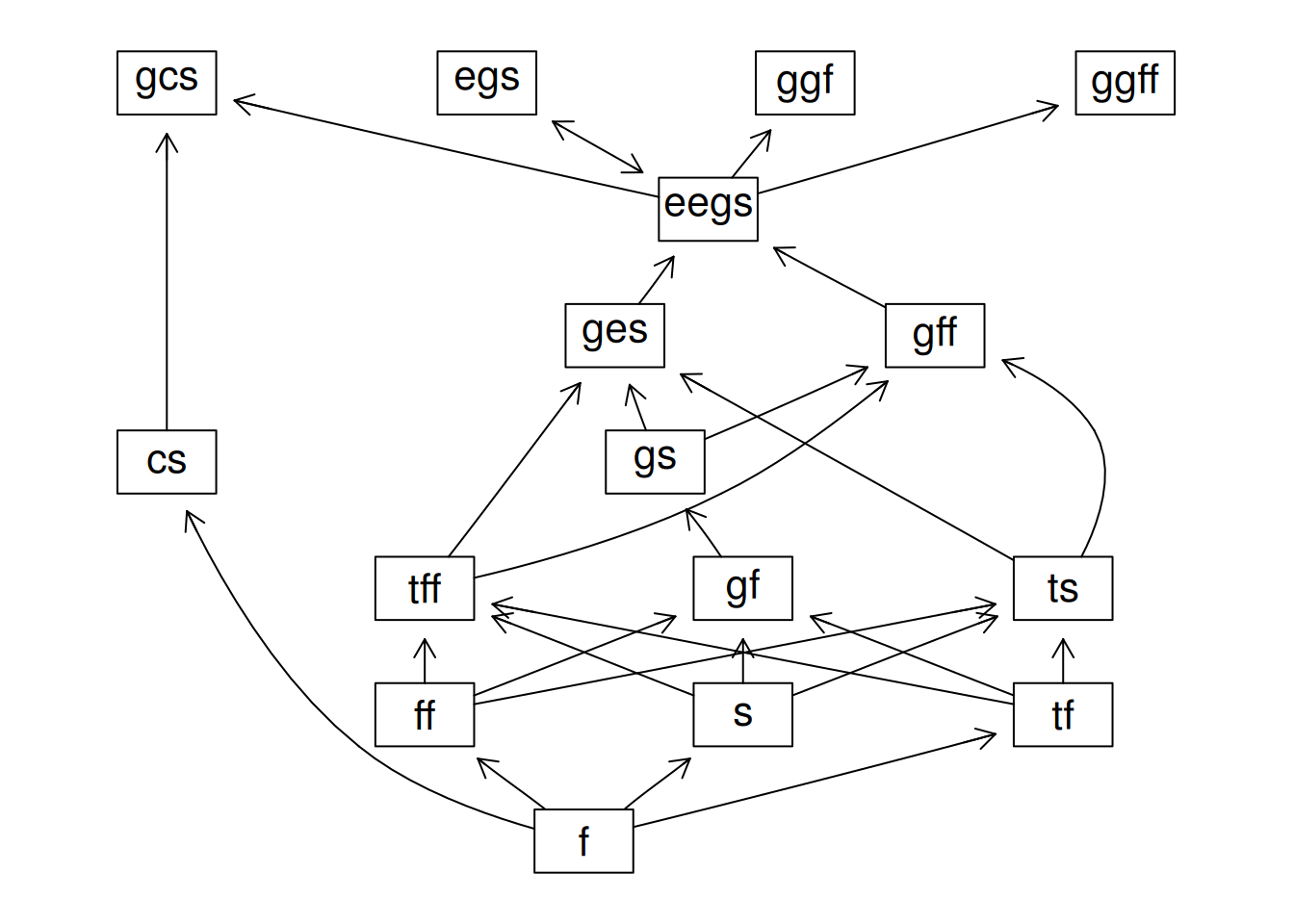
ITA seeks to establish a precedence relation among a set of binary items. For each pair of items \((p, q)\), it counts how often \(p\) is not solved if \(q\) is solved, which constitutes a violation of the relation. ITA searches for a threshold L for the maximum number of violations consistent with a (transitive) precedence relation. Its attempts to minimize the total discrepancy between R and K.
See van Leeuwe (1974) and Schrepp (1999) for details.
Value
An object of class ita having the following components:
K
|
the knowledge structure corresponding to the precedence relation.
|
discrepancy
|
the discrepancy between R and K (fit), between K and R (complexity), and their sum (total).
|
transitiveL
|
the vector of transitive thresholds.
|
searchL
|
either NULL or the method used for threshold search.
|
L
|
the selected or requested threshold.
|
P
|
the precedence matrix containing the number of violations.
|
I
|
the precedence relation as a logical incidence matrix at threshold L.
|
References
Schrepp, M. (1999). On the empirical construction of implications between bi-valued test items. Mathematical Social Sciences, 38(3), 361–375. doi:10.1016/S0165-4896(99)00025-6
Van Leeuwe, J.F. (1974). Item tree analysis. Nederlands Tijdschrift voor de Psychologie en haar Grensgebieden, 29(6), 475–483.
Examples
Item tree analysis (ITA)

Violations of precedence relation:
      >
<       s gs egs eegs cs gcs ts ges  f gf gff ggff ggf ff tf tff
  s     0  0   0    0 10   0  3   1 22  1   0    0   0 11 10   3
  gs   33  0   0    2 18   3 19   6 52  7   6    1   2 30 32  12
  egs  42  9   0    3 18   4 24  10 60 13  10    3   2 39 36  17
  eegs 45 14   6    0 20   6 26  14 63 16  13    6   4 42 40  20
  cs   46 21  12   11  0   5 28  18 55 25  20   12   8 41 37  25
  gcs  48 18  10    9 17   0 31  16 66 22  16    9   7 47 43  22
  ts   24  7   3    2 13   4  0   5 39  8   6    2   1 23 20   8
  ges  36  8   3    4 17   3 19   0 53 11   8    4   4 34 30  13
  f     4  1   0    0  1   0  0   0  0  0   0    1   0  2  2   1
  gf   30  3   0    0 18   3 16   5 47  0   2    1   1 26 28   9
  gff  36  9   4    4 20   4 21   9 54  9   0    4   2 34 34  12
  ggff 47 15   8    8 23   8 28  16 66 19  15    0   7 44 43  21
  ggf  48 17   8    7 20   7 28  17 66 20  14    8   0 46 43  21
  ff   15  1   1    1  9   3  6   3 24  1   2    1   2  0 11   3
  tf   16  5   0    1  7   1  5   1 26  5   4    2   1 13  0   4
  tff  31  7   3    3 17   2 15   6 47  8   4    2   1 27 26   0

Selected threshold (L): 4
Transitive thresholds:
[1]  0  2  4  5  6 66