Conversion between Representations of Responses or States

Description

Converts between binary matrix and pattern representations of response patterns or knowledge states.

Usage

as.pattern(R, freq = FALSE, useNames = FALSE, as.set = FALSE,
           sep = "", emptyset = "{}", as.letters = NULL)

as.binmat(N.R, uniq = TRUE, col.names = NULL, as.logical = FALSE)

is.subset(R)

Arguments

R an indicator matrix of response patterns or knowledge states.
N.R either a (named) vector of absolute frequencies of response patterns; or a character vector of response patterns or knowledge states; or a set of sets representing the knowledge structure.
freq logical, should the frequencies of response patterns be reported?
uniq logical, if TRUE, only the unique response patterns are returned.
useNames logical, return response patterns as combinations of item names.
as.set logical, return knowledge states as set of sets.
sep character to separate the item names.
emptyset string representing the empty set if useNames is TRUE.
as.letters deprecated, use useNames instead.
col.names column names for the state or response matrix.
as.logical logical, return logical matrix of states.

Value

as.pattern returns a vector of integers named by the response patterns if freq is TRUE, else a character vector. If as.set is TRUE, the return value is of class set.

as.binmat returns an indicator matrix. If as.logical is TRUE, it returns a logical matrix.

is.subset returns a logical incidence matrix of the subset relation among states.

See Also

blim, set in package sets.

Examples

library("pks")

data(DoignonFalmagne7)
K <- DoignonFalmagne7$K
as.pattern(K, freq = TRUE)
00000 01000 10000 11000 11010 11100 11101 11110 11111 
    1     1     1     1     1     1     1     1     1 
[1] "00000" "10000" "01000" "11000" "11100" "11010" "11110" "11101" "11111"
as.pattern(K, useNames = TRUE)
[1] "{}"    "a"     "b"     "ab"    "abc"   "abd"   "abcd"  "abce"  "abcde"
as.pattern(K, as.set = TRUE)
{{}, {"a"}, {"b"}, {"a", "b"}, {"a", "b", "c"}, {"a", "b", "d"}, {"a",
 "b", "c", "d"}, {"a", "b", "c", "e"}, {"a", "b", "c", "d", "e"}}
N.R <- DoignonFalmagne7$N.R
dim(as.binmat(N.R))
[1] 32  5
dim(as.binmat(N.R, uniq = FALSE))
[1] 1000    5
## Knowledge structure as binary matrix
as.binmat(c("000", "100", "101", "111"))
     a b c
[1,] 0 0 0
[2,] 1 0 0
[3,] 1 0 1
[4,] 1 1 1
as.binmat(set(set(), set("a"), set("a", "c"), set("a", "b", "c")))
     a b c
[1,] 0 0 0
[2,] 1 0 0
[3,] 1 0 1
[4,] 1 1 1
as.binmat(c("000", "100", "101", "111"), as.logical = TRUE)
         a     b     c
[1,] FALSE FALSE FALSE
[2,]  TRUE FALSE FALSE
[3,]  TRUE FALSE  TRUE
[4,]  TRUE  TRUE  TRUE
## Subset relation incidence matrix
is.subset(K)
       >
<       00000 10000 01000 11000 11100 11010 11110 11101 11111
  00000  TRUE  TRUE  TRUE  TRUE  TRUE  TRUE  TRUE  TRUE  TRUE
  10000 FALSE  TRUE FALSE  TRUE  TRUE  TRUE  TRUE  TRUE  TRUE
  01000 FALSE FALSE  TRUE  TRUE  TRUE  TRUE  TRUE  TRUE  TRUE
  11000 FALSE FALSE FALSE  TRUE  TRUE  TRUE  TRUE  TRUE  TRUE
  11100 FALSE FALSE FALSE FALSE  TRUE FALSE  TRUE  TRUE  TRUE
  11010 FALSE FALSE FALSE FALSE FALSE  TRUE  TRUE FALSE  TRUE
  11110 FALSE FALSE FALSE FALSE FALSE FALSE  TRUE FALSE  TRUE
  11101 FALSE FALSE FALSE FALSE FALSE FALSE FALSE  TRUE  TRUE
  11111 FALSE FALSE FALSE FALSE FALSE FALSE FALSE FALSE  TRUE
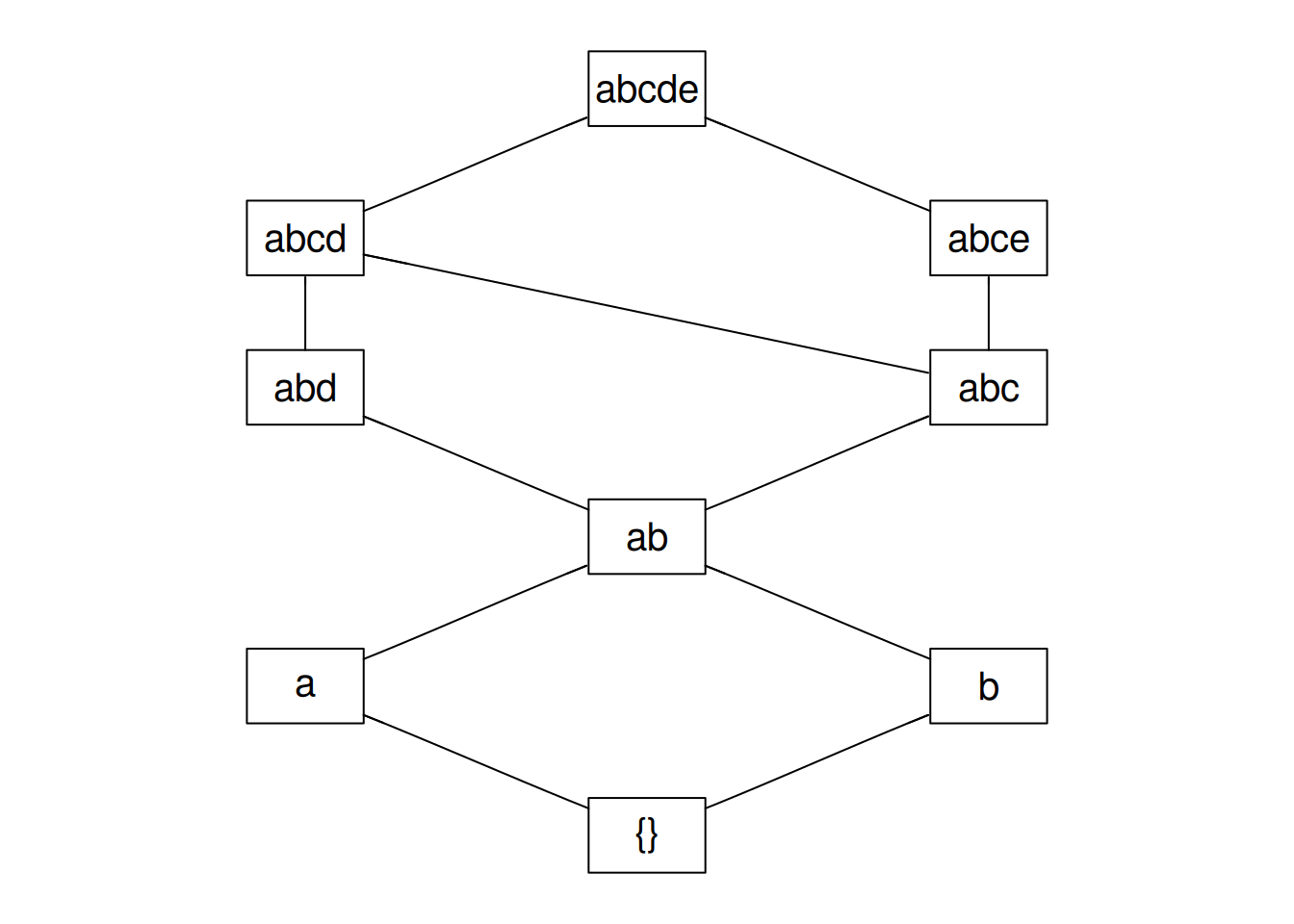
## Plotting the knowledge structure
if(requireNamespace("relations") &&
   requireNamespace("Rgraphviz")) {
  rownames(K) <- as.pattern(K, useNames = TRUE)
  plot(relations::as.relation(is.subset(K)), main = "")
}