Responses to Geometry Problems and Knowledge Structures
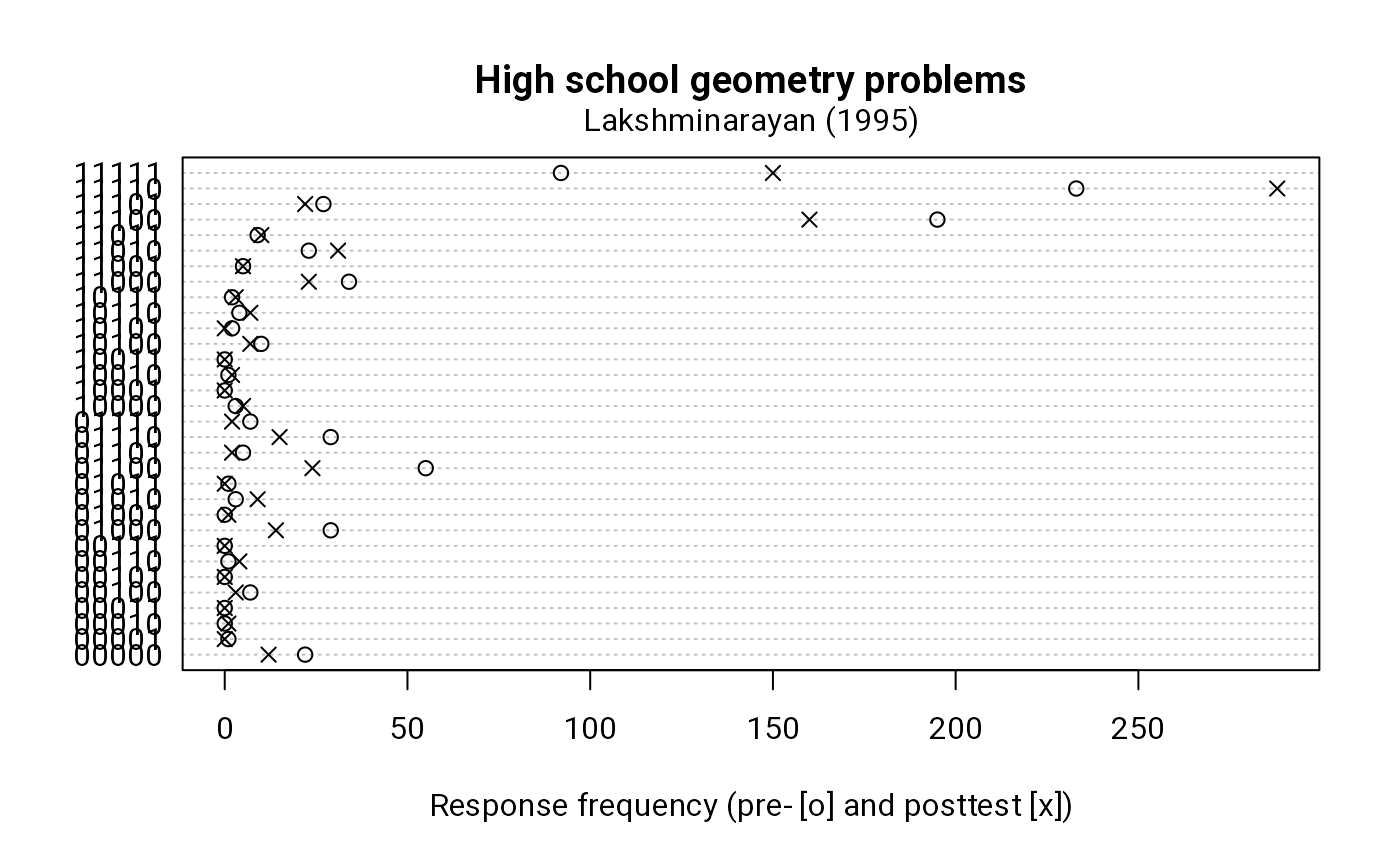
hsgeometry.RdLakshminarayan (1995, 1996) presented high school geometry problems to 959 undergraduate students before and after a lesson. The problems deal with basic concepts in geometry, such as angles, lengths, circles, and polygons. Doignon and Falmagne (1999, chap. 8) refer to a subset of these data.
data(hsgeometry)Format
Two lists, each consisting of three components:
anglesa list with components
K,N.R, andchangescorefor five problems mostly about angles.circlesa list with components
K,N.R, andchangescorefor four problems mostly about circles.Ka state-by-problem indicator matrix representing the knowledge structure in Lakshminarayan (1995, 1996).
N.Ra matrix. The row names denote response patterns, the column entries their frequencies before and after the lesson.
changescorea 3d table. For each problem, it contains the number of students who solved or did not solve the problem at pre- and posttest.
Note
Only those 800 responses used to estimate the model parameters are reported (the held-out sample is missing).
Thanks to Kamakshi Lakshminarayan, Cord Hockemeyer, and Mike Regenwetter for their help with finding the data.
Source
Lakshminarayan, K (1996). A hybrid latent trait and latent class model of learning - Theoretical details and empirical application. Technical report No. MBS 96-07. University of Califomia, Irvine.
References
Doignon, J.-P., & Falmagne, J.-C. (1999). Knowledge spaces. Berlin: Springer.
Lakshminarayan, K. (1995). Theoretical and empirical aspects of some stochastic learning models. Doctoral dissertation. University of California, Irvine.